
Who Should Own AI in the C-Suite? Start With the Mandate
July 8, 2026
Who should own AI in the C-suite? The executive accountable for the business outcome should own the mandate. The CFO may lead when the goal is better forecasting or controls. The COO may lead when the priority is workflow redesign and productivity. The CTO or CIO may lead when data, architecture, security, or model governance is the central challenge. A Chief AI Officer can be right for a company-wide transformation, but only with real authority. The title should follow the outcome, not come before it.
AI ownership is an execution question
AI has moved from experimentation to an operating priority. Yet companies often begin by debating titles: Chief AI Officer, Head of AI, Chief Data and AI Officer, or another variation. That sequence creates risk because candidates may interpret the same title as a technology build, product role, governance function, or enterprise transformation.
The barriers identified by private equity leaders make the execution challenge clear. In PitchBook's Q2 2026 US PE Breakdown, US PE respondents named data readiness as the greatest impediment to faster AI adoption across their portfolios at 26%. Cost justification or unclear ROI followed at 22%, management bandwidth at 20%, and talent at 15%.
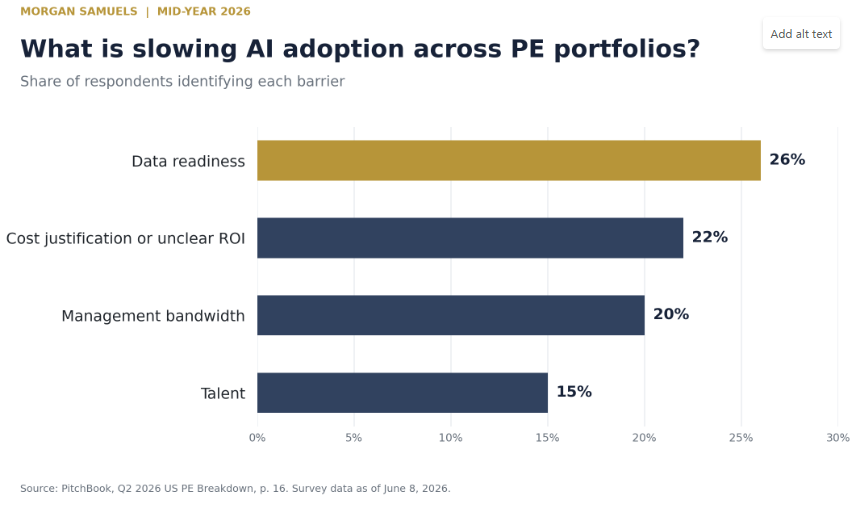
Leading impediments to accelerating AI adoption across US private equity portfolios. Source: PitchBook, Q2 2026 US PE Breakdown, page 16. Original visualization by Morgan Samuels.
Those are not enthusiasm problems. They are operating problems. AI needs access to workflows, trusted data, budget, technical infrastructure, and leaders who can change how work gets done.
Match the accountable executive to the outcome
There is no universal AI ownership model. The strongest model places accountability close to the economic result while formally assigning the partners who control the required capabilities.
How ownership may change by business outcome:
Enterprise productivity and workflow redesign:
Likely owner: COO.
Required partners: CIO or CTO, CFO, CHRO, and business-unit leaders.
Data platforms, security, integration, and model governance:
Likely owner: CIO or CTO.
Required partners: CDO, CISO, legal, risk, and functional owners.
Forecasting, controls, fraud, or finance productivity:
Likely owner: CFO.
Required partners: CIO or CTO, COO, audit, and risk.
Personalization, acquisition efficiency, or customer experience:
Likely owner: CMO or CRO.
Required partners: CIO or CTO, product, data, and legal.
AI-enabled products or revenue:
Likely owner: CPO, CTO, or the relevant business-unit leader.
Required partners: Engineering, sales, finance, and legal.
Enterprise-wide AI transformation:
Likely owner: Chief AI Officer, COO, or another designated executive.
Required partners: CEO, CIO or CTO, CFO, CHRO, and functional leaders.
This framework is a starting point, not a rigid organization chart. In some companies, the same leader may own several outcomes. In others, a functional executive owns the result while a central technology or data team provides the platform.
Set the Chief AI Officer reporting structure around the mandate
A Chief AI Officer reporting structure should reflect the work the leader is expected to control. An enterprise-wide mandate that crosses functions and reallocates resources usually requires direct access to the CEO or COO. A role centered on technical platforms, data, and model deployment may fit under the CTO or CIO. A role focused on operational transformation may be most effective under the COO.
The reporting line matters, but decision rights matter more. A senior title without authority over priorities, budgets, data standards, or business-unit participation creates a visible coordinator, not an accountable operator.
AI needs one accountable owner and a cross-functional operating model
One executive should be accountable, but no executive can deliver AI alone. An effective AI ownership model clarifies five roles:
The board and CEO set priorities, risk appetite, and investment expectations.
The accountable executive owns the roadmap, results, and tradeoffs.
Technology and data leaders provide secure, reliable infrastructure.
Functional leaders own adoption and performance within their workflows.
The CFO validates the economics and measures value; the CHRO redesigns roles and builds capabilities.
For private equity firms, accountability operates at two levels. The sponsor can set expectations, share expertise, and challenge the value-creation case. The portfolio company CEO and management team must still own execution. A portfolio resource can accelerate learning, but it cannot replace local authority.
Define the role before beginning the executive search
Before choosing a title or candidate profile, boards and CEOs should agree on five points:
Outcomes. What measurable value should AI create over the next 12 to 18 months?
Mandate. Is the leader building infrastructure, deploying use cases, redesigning workflows, creating products, or governing risk?
Decision rights. Can the leader prioritize initiatives, redirect budget, set standards, and require participation?
Resources. What team, funding, data access, and executive sponsorship will the role control?
Scorecard. Will success be measured through adoption, financial impact, customer outcomes, cycle-time reduction, or risk mitigation?
Only then should the organization decide whether it needs a Chief AI Officer, a Chief Data and AI Officer, a technology executive, an operating leader, or a functional owner. Morgan Samuels applies the same mandate-first discipline in its executive search approach, particularly when helping technology businesses identify leaders who can translate strategy into measurable performance.
The title is the final decision
The strongest AI leaders combine technical fluency with business judgment, influence, and execution. Even an exceptional leader will struggle in an ambiguous role.
Define the outcome, authority, resources, partners, and measures first. Then hire the executive whose experience matches the work. That is how AI moves from an initiative everyone supports to an operating capability someone can actually deliver.
Frequently asked questions
Should every company hire a Chief AI Officer?
No. A dedicated Chief AI Officer makes sense when AI is an enterprise-wide priority that requires sustained coordination and authority across functions. If the priority is concentrated in technology, operations, finance, marketing, or product, an existing executive may be the stronger owner.
Who should a Chief AI Officer report to?
The Chief AI Officer should report to the executive who can grant the authority needed for the mandate. Enterprise transformation commonly requires access to the CEO or COO. A platform-centered role may report to the CTO or CIO.

About the Author
Tom Dunn is a Senior Client Partner at Morgan Samuels. A West Point graduate, former Army officer, and former McKinsey consultant, he advises clients on leadership across strategy, operations, finance, and transformation
Source Note
PitchBook, Q2 2026 US PE Breakdown, p. 16, published July 6, 2026. The AI-adoption survey reflected US private equity respondents and was current as of June 8, 2026.